


Keeping customers happy is super important for any business. When people love your service or product, they’re not just likely to come back for more; they’ll probably tell their friends about it. That’s why businesses pay a lot of attention to figuring out how happy their customers are.
One popular way to do this is by looking at the CSAT score. According to a study by Hiver, 41% of customer support teams say that tracking CSAT is their top priority. This is a clear indicator that keeping customers happy is key to success.
So, how do you translate this goal into an actionable plan? To find this out, we had a conversation with Jordan Hooker – a seasoned customer experience (CX) professional and Principal Consultant at Tavolo Consulting.
Drawing from his extensive experience, including a significant role as a Senior CX Program Manager, Jordan sheds light on effective strategies for measuring and enhancing customer satisfaction. He discusses the importance of diverse feedback channels and the power of acting on customer feedback.
Q1. In your view, what are the most critical components of an effective customer satisfaction measurement strategy?
I find there are two critical components of an effective customer satisfaction measurement strategy:
- Use Multiple Channels: Customers should have multiple opportunities to provide feedback, whether through surveys like NPS sent on a particular schedule, or during and after the completion of a support interaction. The more we limit the manner in which customers provide us feedback, the less feedback we are likely to see.
- Actioning Feedback: What do you do with the feedback you get? If you collect feedback from your customers and take no action, you’re wasting their time and missing valuable opportunities to improve. Implementing a strategy to ensure the feedback you collect is packaged, shared with the rest of your organization, and then utilized to improve the customer experience is necessary if your organization is going to improve.
Q2. How do you balance the importance of quantitative metrics (like CSAT scores) with qualitative feedback from customers?
Quantitative metrics are important to the story you need to tell, especially to leadership and investors. Seeing trends in these numbers is important, but these are lagging indicators.
The real treasure is the qualitative feedback you get from customers, through something like an NPS survey, and also through real-time feedback as your front-line teams interact with them.
Your teams should be equipped to read and understand the feedback they are receiving so that they can understand how to act on it. The companies that do this best ensure that their front-line teams have a deep knowledge of the product and/or services.
Let’s talk about real-time feedback for a moment. That feedback is truly the proverbial canary in the coal mine—unlike the lagging indicators we mentioned earlier. Real-time feedback can be an early warning sign that something is wrong, giving your team time to fix it before it becomes a larger problem. Teach your frontline teams to collect, assess, and escalate this kind of feedback and give them proper channels to share it.
Q3. Can you share the strategic approach you took to achieve a significant reduction in handle time while simultaneously increasing CSAT/NPS?
In my experience leading support for high-growth startups, I found three elements to be most strategic in reducing handle time, while seeing an increase in CSAT/NPS scores:
- Agent Equipping and Resourcing: The more high-quality resources I provided my team, the more their ability to service customers in an efficient manner increased. I also heavily involved my team in the process of developing and updating those resources, which ensured they were relevant to the work happening on the front lines, as well as providing a sense of ownership for the team.
- Agent Autonomy: I developed operating procedures that allowed my team members to take care of customers in real-time without needing approvals. While this process took time and expanded slowly, equipping the team to make the best decision for the customer allowed us to solve customer problems more quickly.
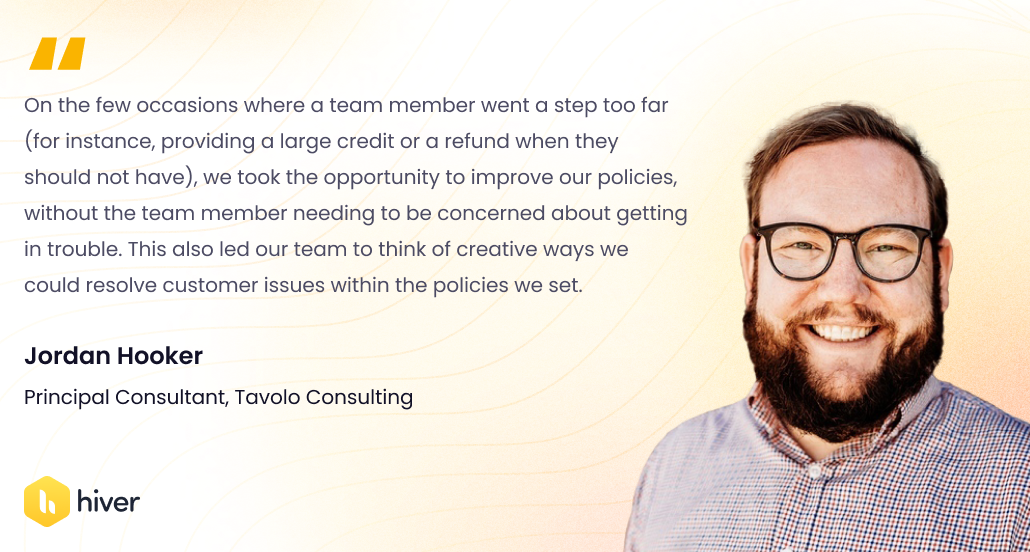
- Feedback Loop: We took action on the feedback we received and empowered our support agents to own that process. As team members identified trends, they were provided with the opportunity to write up feedback, the impact an issue was having, and potential solutions. In taking ownership of that process, our agents developed a strong cross-functional partnership with product and engineering, resulting in products and features that our customers loved. While it took time, customers could see that the feedback they provided resulted in changes, leading to happier customers and reduced ticket volume.
Q4. What specific tactics or operational changes were most effective in reducing the cost-to-service without compromising on customer satisfaction?
In my experience, organizations are not often using the tools they own to their full potential, resulting in numerous tools built on top of each other. This increases the complexity of their systems and, ultimately, cost-to-service.
Tool selection is critical here – are you trying to build a Rolls-Royce when a Honda will do? And of the tools you own, are you utilizing all the features available, or purchasing another tool (or building a custom configuration), when it is not necessary? This is also another critical time to give your frontline teams more ownership – they know what they need to do their job, so include them in the conversation.
Q5. What were some of the biggest challenges you faced in improving customer satisfaction metrics, and how did you overcome them?
I keep the cork from a bottle of champagne on my desk – it’s a reminder of nearly a quarter’s worth of work my team put in to move the needle on customer satisfaction metrics.
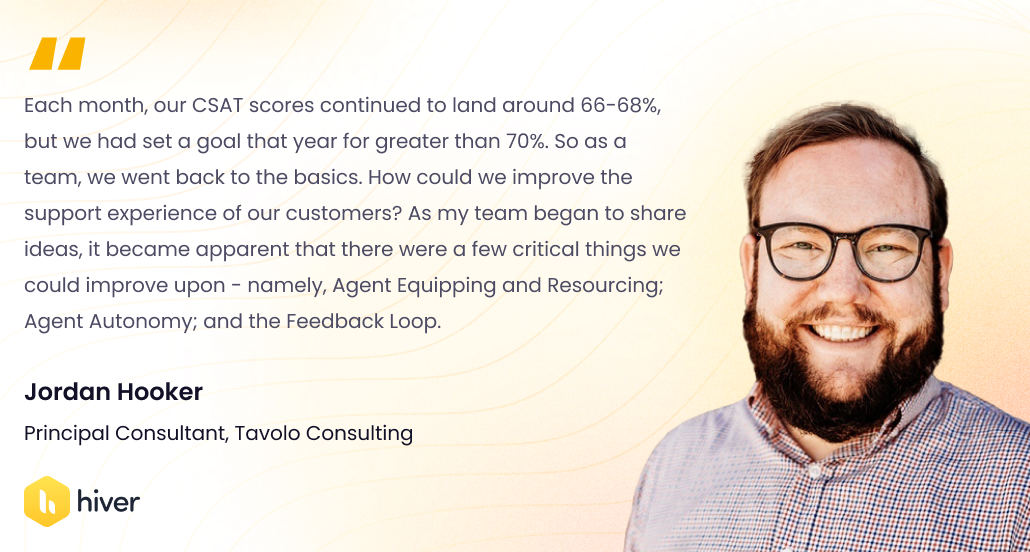
We had components of all three things in place, but the more we thought through the challenges our frontline teams were facing, the more we saw room for improvement in each of these areas. So, we started working to improve each component and gave ownership to the team.
And the result? That score ticked up to 71.2%. And then it kept going. The day I published those reports, I went and bought that bottle of champagne so we could celebrate together.
Conclusion
And that’s a wrap on our conversation with Jordan Hooker.
If there’s one thing we’ve learned, it’s that there’s no magic formula or secret sauce.
It’s about getting back to basics: listening, understanding, and acting on what your customers tell you. Jordan shared his playbook with us, from opening up channels for feedback to making sure every piece of advice from customers helps shape a better experience.
It’s clear that improving customer satisfaction is a team sport, and everyone from the front lines to the back office plays a part.
By using Hiver to add a CSAT survey at the end of every support interaction, you can clearly see who is happy with your service and who is not.

And it’s not just about collecting this feedback; Hiver also lets you measure it and extract insights in real-time. This is super helpful because it means you can quickly see how you’re doing and make any necessary adjustments.